
What to Do Before Opening Your Second Restaurant
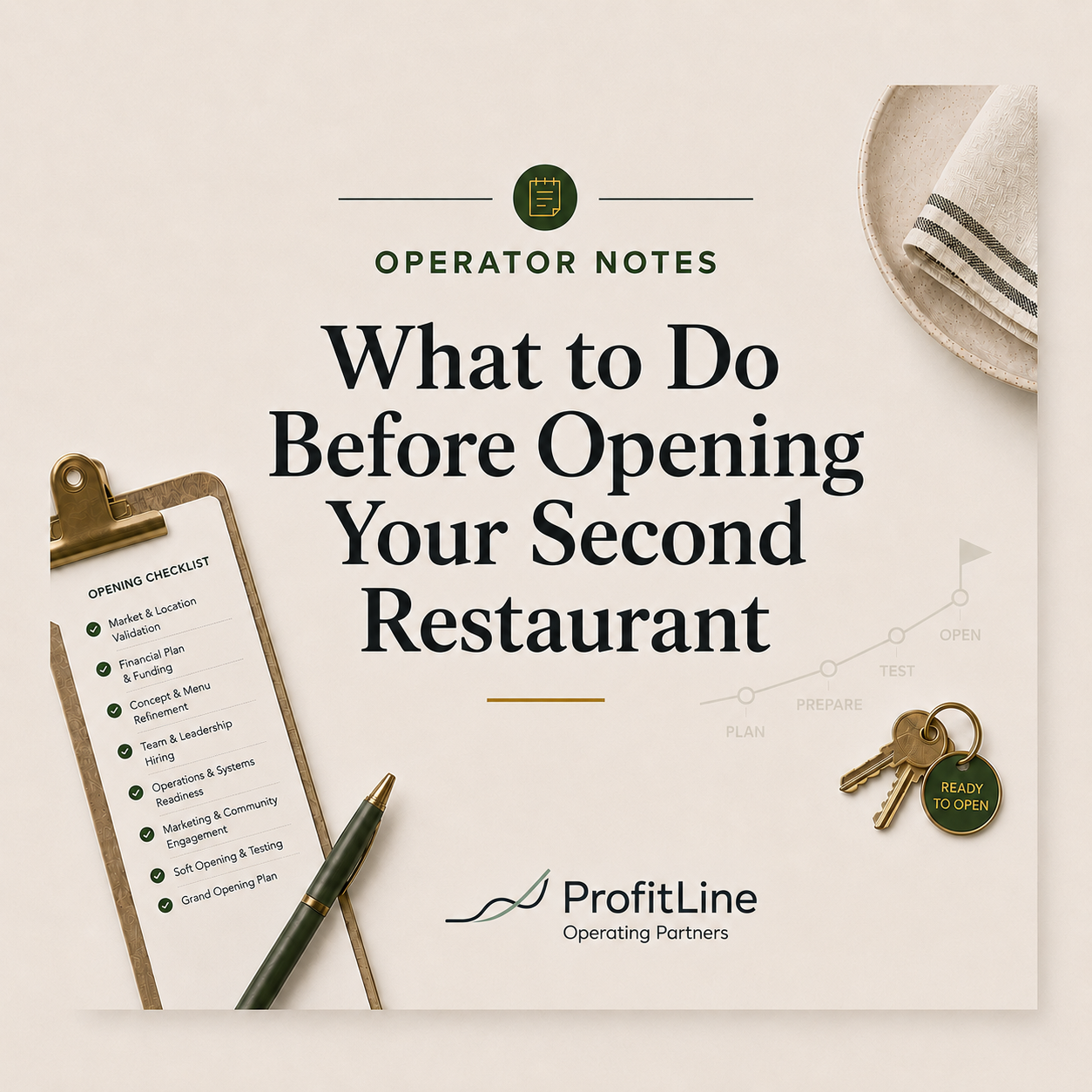
Opening your second restaurant is where you find out whether you have a business that can scale or one great location being held together by hustle.
This article breaks down what operators should have in place before opening location two, including leadership structure, training systems, labor planning, opening timelines, and the operating rhythm needed to protect both the new restaurant and the original one.
Opening the second restaurant is where a lot of operators find out whether they have a business or just one great location. That is not meant to be harsh. I’ve just found it to be true, time and time again.
The first restaurant can run on hustle, founder presence, a few key people, and a lot of daily heroics. The second one exposes everything: weak training, unclear standards, no real leadership bench, loose food cost controls, no operating rhythm, no documented systems, and too much dependency on the owner/founder.
The second location does not create those problems. It reveals them.
Do not assume the first location is ready to be copied
A busy first restaurant can fool you. Strong sales do not always mean the model is ready to scale.
Before opening a second location, ask:
Can the first store run well without the founder there every day?
Are standards and procedures documented?
Do managers know how to train people consistently?
Is food cost under control?
Is labor managed well?
Are recipes followed?
Is there a weekly performance rhythm?
Are roles clear?
Do we know what makes the first location work?
If the answer is mostly “it depends on who is working,” you are not ready to scale the system. You are getting ready to duplicate the chaos.
Build the leadership structure first
A second restaurant changes the owner’s job. You cannot be everywhere anymore.
That means you need a real leadership structure before the opening pressure hits.
You need to know:
Who owns operations?
Who owns training?
Who owns food quality?
Who owns hiring?
Who owns opening readiness?
Who owns financial performance?
Who makes decisions when the founder is not there?
If everything still runs through the founder, the second location will stretch the business thin fast. Growth requires role clarity, not fancy org charts, real clarity. This is where having a strong GM in place at the first restaurant is critical.
Create a training system before you need it
If you want to grow, training cannot live in someone’s head.
Before opening the second restaurant, you need a clear training structure around:
FOH roles
BOH roles
Manager training
Opening and closing standards
Service expectations
Food quality
Prep systems
Guest recovery
Position certification
New hire ramp-up and training after-the-fact.
The goal is not to create a giant manual no one reads. The goal is to make training repeatable.
If the second store depends on your best person explaining everything from memory, you are taking on unnecessary risk.
Build your opening plan early
A second (or third or fourth) opening needs more than a checklist. It needs a timeline.
At a minimum, you should be thinking in terms of:
120 days out
90 days out
60 days out
30 days out
2 weeks out and training week
Opening week
First 30 days post-opening
First 90 days post-opening
You need clarity around buildout, hiring, training, vendor setup, leadership readiness, equipment, recipe execution, POS setup, labor model, opening inventory, marketing, soft opening, and post-opening support.
Most bad openings do not fail on opening day. They fail in the months leading up to opening day. Opening day makes it visible since it’s when guests are actually coming in the door.
Know your labor model
Do not wait until the week before opening to figure out staffing. Before opening a second location, build the labor model.
Know:
Staffing pars by position
Are there any fundamental changes to the line setup?
Management structure
Training hours
Opening ramp labor (how to deploy labor vs. sales)
Sales assumptions (forecasts)
Labor targets by sales level
Daypart staffing
Opening week support
Post-opening stabilization plan
A new restaurant usually needs more labor early. That is normal. But without a plan, the team either overreacts and cuts too fast or carries too much labor with no path to control. Both are expensive.
Protect the first location
This is one of the most overlooked parts. Opening a second restaurant can damage the first one.
You pull your best people, the founder/owner gets distracted, training energy shifts, standards slip, regulars feel it, and managers get stretched.
Before you open, decide how you are going to protect the original location. After all, its success is what is prompting you to open a second one.
Who stays? Who transfers? Who backfills? Who supports the GM? What standards need extra inspection? Growth should not weaken the base.
Create a performance rhythm before opening
Do not wait until the restaurant is open to start managing performance.
You need a rhythm from the beginning.
That includes:
Daily opening huddles (pre-shifts)
Weekly leadership check-ins
Labor review
Food cost review
Guest feedback review
Training progress review or any make-up training that needs to happen
Issue tracking
Sales ramp review (how are we tracking vs. the plan/forecast?)
Prime cost monitoring
A new restaurant needs attention, not panic. The rhythm gives the team a way to find issues early and fix them before they become normal.
The real question
Before opening your second restaurant, the question is not:
Can we open another one?
The better question is:
Can we operate another one without breaking what made the first one work?
That is the difference between expansion and strain.
Growth is exciting. But growth without systems gets expensive fast.
If you are preparing for a second location, the best time to build the operating structure is before the lease is signed, before the managers are overwhelmed, and before opening week exposes every gap. Put these things in place FIRST, to make it easier to repeat them for units 2, 3, 4, and more.
That is the work ProfitLine supports through New Restaurant Opening Consulting, Restaurant Training Systems, and Fractional Operations Leadership.
