
Should You Hire a Restaurant Consultant?
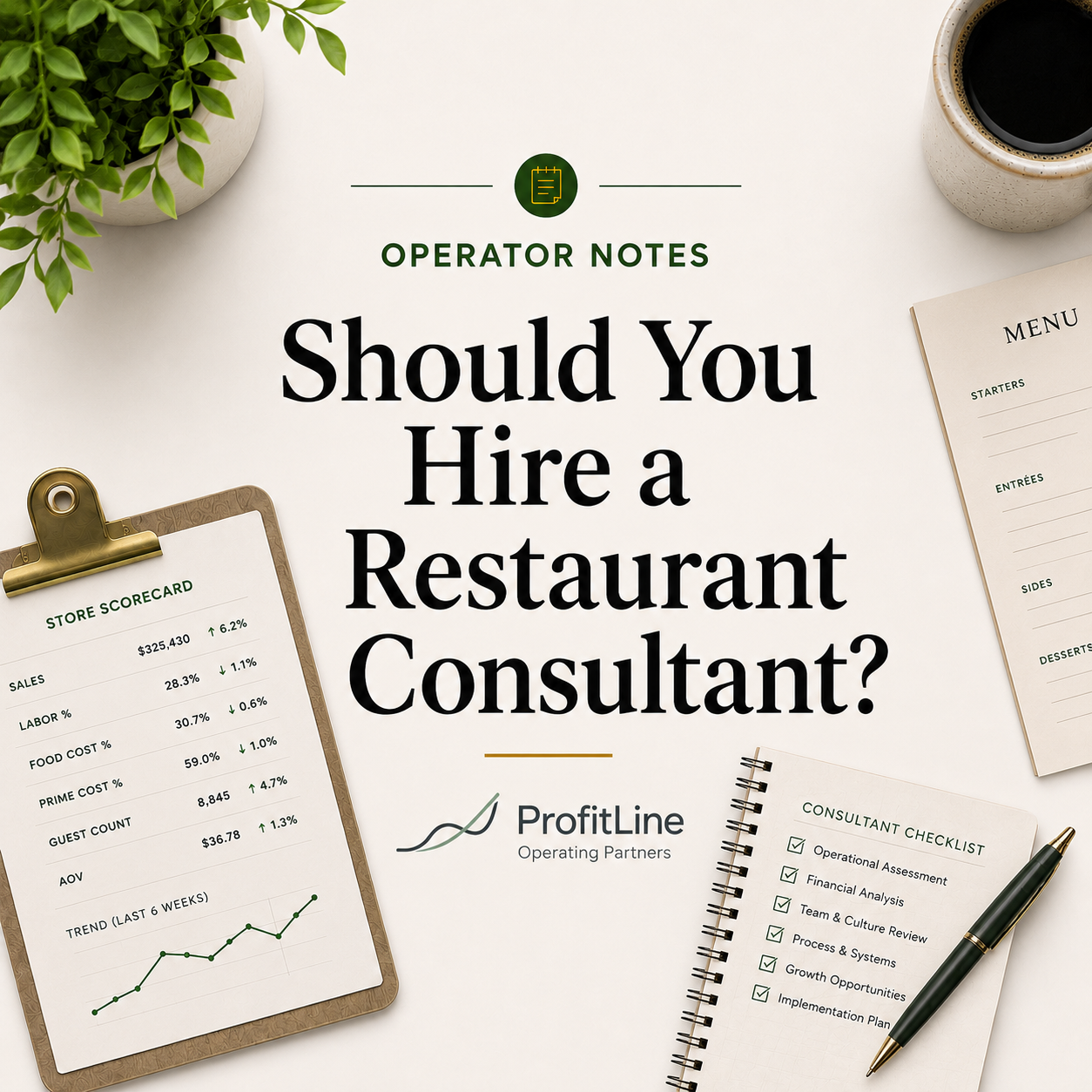
Hiring a restaurant consultant can be useful. It can also be a waste of money if you are not clear on what you need.
That is the honest answer.
A consultant should not just give you more ideas and homework. Most restaurant owners already have plenty of ideas. The better question is whether you need help diagnosing the real issue, building the right system, and getting the team to follow through.
Start with the problem
Before hiring a restaurant consultant, get specific about the pain.
Is the cost of goods sold too high?
Is labor drifting?
Are managers inconsistent?
Are you opening another location?
Is training mostly tribal knowledge?
Are sales flat?
Are guest complaints increasing?
Are the P&Ls telling you something is wrong, but you are not sure what is causing it?
The more specific the problem, the more useful the engagement can be. If the goal is just “make us better,” the work can get fuzzy fast.
A good consultant should connect ideas to execution
Restaurants do not need more theory. I’ve worked in restaurants for a long time, and rarely is theory ‘new’. Restaurants need ideas/plans that can survive the shift and be executed consistently.
A good restaurant consultant should understand how the recommendation will actually work in the building. I call this the ‘operational lens’.
Who owns it?
When does it happen?
How will managers use it?
How will it be measured?
What happens when the restaurant gets busy?
How does it affect labor, food cost, sales, guest experience, or manager workload?
If those questions are not asked, the work may remain on the surface.
Sometimes you need a specialist
There are times when a narrow expert makes sense. Menu engineering, bar systems, real estate, franchise development, marketing, HR, supply chain, kitchen design, and accounting. Those are specific lanes, and the right specialist can help.
Oftentimes, the problem crosses multiple parts of the business. Food cost may be tied to prep, ordering, training, portioning, inventory, menu mix, and manager follow-up. Labor may be tied to forecasting, scheduling, staffing, training, and daily adjustment. Growth issues may be tied to leadership structure, standards, systems, and the founder still being the glue.
That is where broader operations support can help.
You need to be ready to act
A consultant should diagnose and recommend. They can build tools, coach leaders, and help install rhythm.
But the restaurant still has to do the work. If ownership is not ready to make decisions, hold people accountable, or protect the work once it starts, the engagement will struggle. Outside help works best when the owner wants the truth, the team is willing to engage, and there is a clear path from recommendation to execution.
What good Performance looks like
A good consulting engagement should leave the business with more clarity and a defined action plan.
You should know what problem is being solved.
You should know what the consultant is doing.
You should know what the team is expected to do.
You should have a rhythm for communication and follow-up.
You should be able to point to tools, decisions, systems, or performance improvements that came from the work.
It does not have to be complicated. It does have to be useful.
Final thought
You should hire a restaurant consultant when the cost of staying stuck is greater than the cost of getting help.
That might mean improving prime cost, building training systems, opening a new restaurant, tightening manager accountability, or creating a better operating rhythm.
The right consultant should help you see the problem more clearly and build a practical way to fix it.
The wrong consultant will give you a pretty deck and leave you with the same problems.
How ProfitLine Operating Partners can help
ProfitLine Operating Partners works with restaurant brands that need practical help improving operations, performance, training, and growth systems, to ultimately improve results.
That can include profit diagnostics, performance improvement sprints, fractional operations leadership, new restaurant opening support, and training system development.
The goal is to help owners fix the systems behind the numbers without making the business feel more complicated than it needs to be.
