
Why the Multi-Unit Leader Makes or Breaks Restaurant Growth
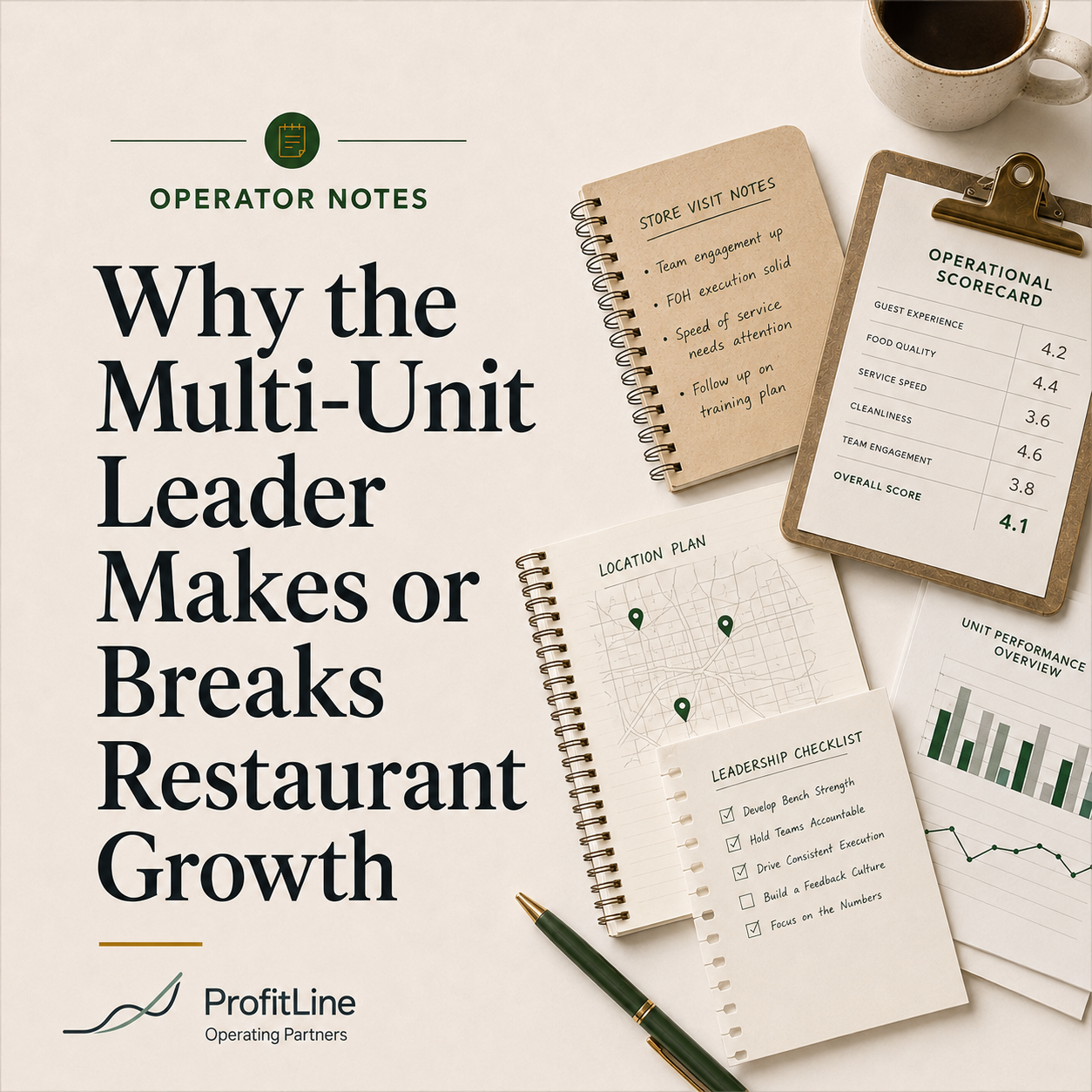
A strong multi-unit leader can change the whole direction of a restaurant group. Not because they sit in meetings and talk about strategy. They are the link between what ownership wants and what actually happens in the restaurants.
That role matters more than a lot of operators realize.
A good multi-unit leader sees patterns. They know which GM needs coaching, which store is slipping, which manager is hiding behind excuses, which location has a staffing issue, and which problem is really a system problem.
They are close enough to the restaurants to see reality, but far enough from the shift to connect the dots. That is a hard seat to sit in.
They translate priorities into behavior
Ownership may say, “We need to improve labor.” The multi-unit leader has to turn that into better schedules, smarter cuts, stronger forecasting, and managers who know what labor should look like by daypart.
Ownership may say, “We need a better guest experience.” The multi-unit leader has to look at training, hospitality standards, ticket times, manager presence, staffing levels, and follow-up.
Ownership may say, “We need consistency.” The multi-unit leader has to make sure the standards are not changing by location, by GM, or by whoever is working that night.
They protect the operating rhythm
The best multi-unit leaders do not just visit stores and put out fires. They build rhythm.
GM check-ins.
Store visits with a purpose.
Scorecard reviews.
P&L conversations.
Staffing plans.
Training follow-up.
Action items that actually get revisited.
Without that rhythm, the role becomes reactive. They spend the week chasing whatever is loudest, and the important work keeps getting pushed. That is how restaurants drift.
They develop GMs
A multi-unit leader’s job is not to be the best GM in the company.
It is to build better GMs. That means coaching managers on how to think, not just telling them what to do.
How do they read their numbers?
How do they manage labor before it gets away from them?
How do they coach a weak manager?
How do they prepare for the weekend?
How do they lead the team instead of just surviving the shift?
If the multi-unit leader is constantly solving every problem for the GM, the GM does not grow. And the multi-unit leader becomes the bottleneck.
They can expose weak systems quickly
If one restaurant is struggling, it may be a GM problem. If three restaurants are struggling with the same issue, it is probably a system problem.
That is where a strong multi-unit leader is valuable. They can tell when the issue is training, staffing, prep, scheduling, standards, communication, or lack of accountability.
They can separate noise from pattern. That keeps ownership from treating every problem like a one-off.
That role needs structure, too
A lot of restaurant groups promote a strong GM into a multi-unit role and assume they will figure it out. Sometimes they do. Sometimes they just become a traveling fixer.
The multi-unit leader needs clear expectations, a visit cadence, scorecards, decision rights, meeting rhythm, and a defined way to coach and follow up with GMs.
Otherwise, the role becomes whatever the week demands. In my experience, that usually means the urgent wins.
Final thought
The multi-unit leader is one of the most important roles in a growing restaurant company.
They turn ownership priorities into store-level execution. They coach GMs, protect standards, spot patterns, and help the business grow without everything depending on the founder.
The role has to be built and trained intentionally. A strong multi-unit leader with the right rhythm can create a lot of lift. A strong operator with no structure can still end up chasing fires all week.
How ProfitLine Operating Partners can help
ProfitLine Operating Partners helps restaurant groups build the structure around operations leadership.
That can include multi-unit visit rhythms, GM scorecards, P&L review cadence, leadership meeting structure, store visit templates, accountability systems, and coaching tools for GMs and field leaders.
The goal is simple: help the operating team spend less time reacting and more time improving the business.
