
What should be on a Restaurant General Manager scorecard?
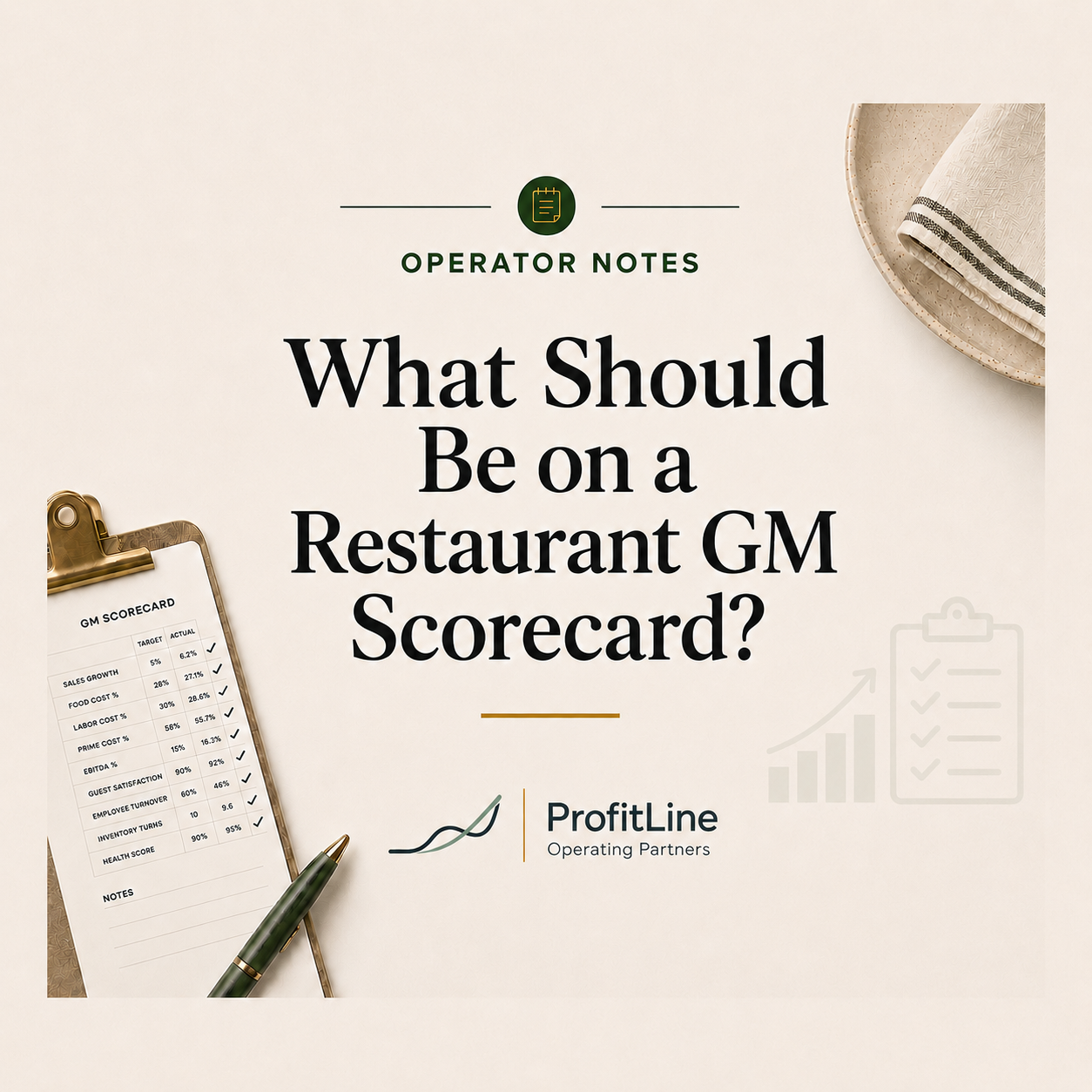
A good GM scorecard should not be complicated.
If it takes a finance degree to understand it, it won't be used.
If it has 47 metrics, it will become wallpaper.
A good restaurant GM scorecard should show the few things that matter most and help the GM understand whether the restaurant is winning, drifting, or in trouble.
The purpose is not to bury managers in numbers. The purpose is to create focus.
Start with the controllables
The GM does not control everything. They do not control the weather. They do not control every vendor increase. They do not control every guest behavior.
But they do control a lot. A GM scorecard should focus on the numbers and behaviors they can influence.
I like to think about it in categories:
Sales
Labor
COGS
Prime cost
Guest experience
People
Standards
Follow-through
That gives you a balanced view of performance.
Sales metrics
Sales should be on the scorecard, but not by itself. Sales without context can be misleading.
Include:
Total sales
Comp sales
Guest count
Check average
Sales by daypart
Sales by channel
Catering or large-order sales, if relevant
Specials or featured item performance
Then ask:
Is the restaurant growing?
Is the growth profitable?
Are we winning in the right dayparts?
Are managers driving the behaviors that support sales?
Sales are not just a marketing result. They are also an execution result. There is ALWAYS an opportunity for a GM to drive sales and traffic.
Labor metrics
Labor belongs on every GM scorecard. But again, do not only show the labor percentage.
I’d include:
Labor percentage
Labor dollars
Labor hours
Sales per labor hour
Overtime
Schedule variance
Training hours, if relevant
Labor percentage tells part of the story. Sales per labor hour tells another part. Schedule quality tells another.
The goal is to help the GM understand labor as a productivity system, not just a number they get yelled at for.
COGS and food cost metrics
For food and beverage cost, include:
Food cost percentage
Beverage cost percentage, if relevant
Total COGS
Inventory variance
Waste
Purchases as a percentage of sales
Key item usage
Recipe or portioning issues, if tracked
This section should help the GM see where margin is being protected or lost.
Food cost does not drift by accident. It usually comes from ordering, waste, prep, portions, theft, recipe execution, pricing, or mix.
The scorecard should make those conversations easier.
Prime cost
Prime cost should always be a core metric. It brings labor and COGS together.
Include:
Prime cost dollars
Prime cost percentage
Labor vs. COGS contribution
Trend vs. prior period and prior year
Store rank if you have multiple locations
Prime cost is one of the best ways to keep the conversation grounded.
If sales are up but prime cost is getting worse, you need to know that. If prime cost is improving, you need to understand why.
Guest experience
Do not build a scorecard that only looks at money. Restaurants are not spreadsheets.
If a GM improves labor at the expense of hospitality, the business will pay for it later.
Include guest experience metrics like:
Review scores
Guest complaints
Secret shop results
Refunds or comps
Speed of service
Ticket times
Table visits
Brand standard scores
The scorecard should protect both profit and the guest.
People metrics
A restaurant’s numbers usually follow the quality and stability of the team.
Include:
Turnover
Staffing level vs. par vs. needs
Open positions
Training completion and crosstraining
Manager bench strength
Certified trainers
Performance conversations completed
This helps leadership see whether the GM is building a business or just surviving the week.
Standards and execution
This section is harder to quantify, but it matters.
You can include:
Cleanliness scores
Food safety results
Line checks completed
Opening/closing checklist completion
Manager walk-through scores
Brand standard inspections
Follow-up items completed
A GM scorecard should not only measure outcomes. It should measure the habits that create the outcomes.
Keep it simple
If I had to start with a simple GM scorecard, I’d use:
Sales
Comp sales
Guest count
Labor %
Sales per labor hour
COGS %
Prime cost %
Review score
Turnover
Staffing vs. par
Standards score
Top 3 action items
That is enough to start a real performance conversation.
The scorecard is not the system
This is the part people miss. A scorecard by itself does not improve performance.
The rhythm and conversation around the scorecard does.
Who reviews it?
How often?
What happens when a number is off?
Does the GM know what to do?
Does the area leader/DM coach from it?
Does the leadership team use it to identify patterns?
That is where the value is.
A GM scorecard is only useful if it changes behavior.
That is why ProfitLine Operating Partners builds scorecards inside a broader operating rhythm through Restaurant Performance Rhythm Installation, Fractional Operations Leadership, and Restaurant Labor Optimization.
