
Why Restaurant Training Fails When Operations Doesn’t Own It
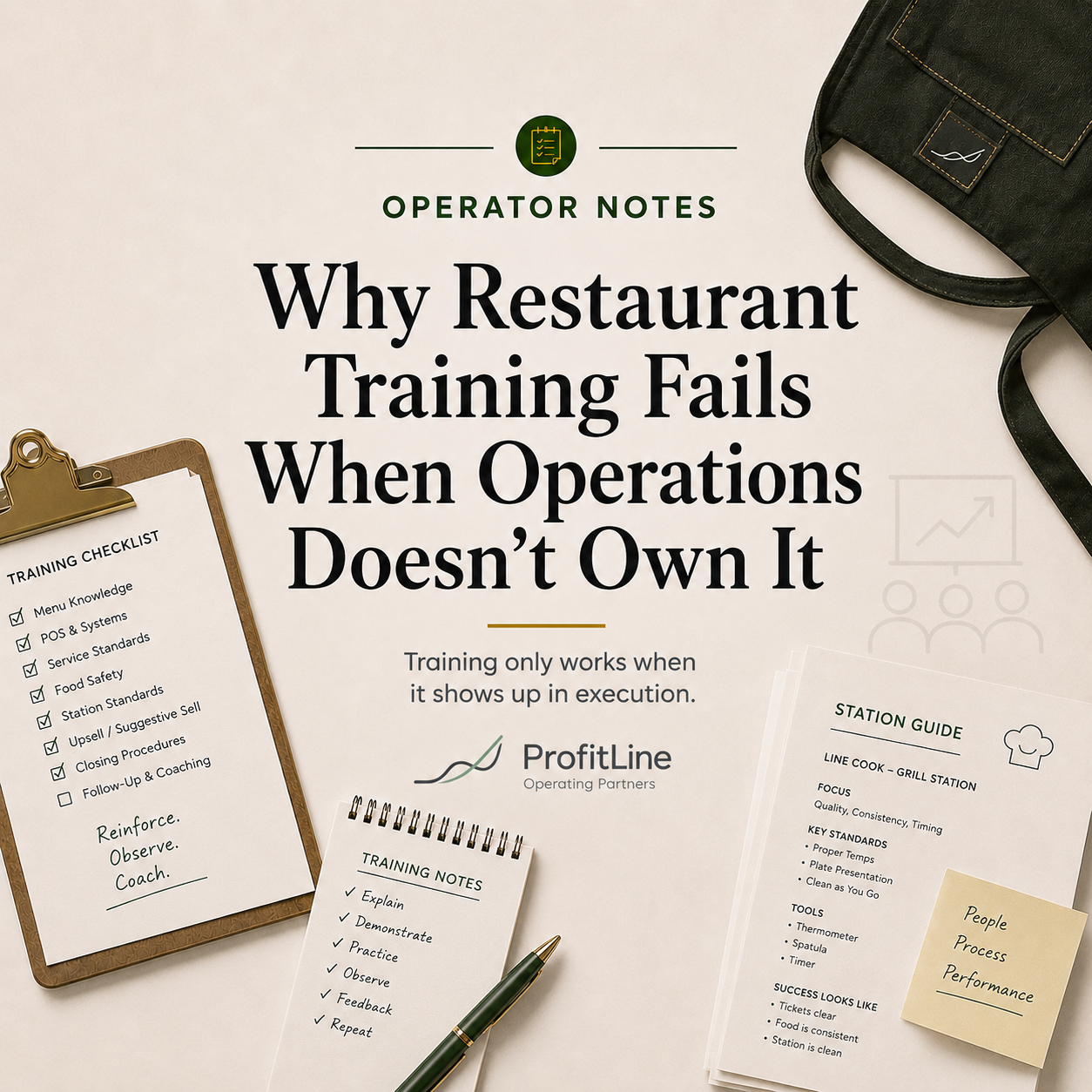
A restaurant training system should not live off to the side. It cannot just sit in a binder, a shared drive, an LMS, or with one person who is “in charge of training.” Those things can help. But training only matters if it shows up during the shift.
The guest does not experience the training checklist. The guest experiences the food, the service, the timing, the cleanliness, the handoff, the recovery, and the consistency of the team working that day.
If those things are off, the training system is either incomplete, ignored, or disconnected from how the restaurant actually runs. That is why operations has to own it.
Training is an operations issue
A lot of restaurants I’ve seen and worked with treat training like a one-time onboarding process. Someone gets hired, they fill out paperwork, and they shadow a few shifts. Maybe they get a checklist. Maybe they watch some videos. Then they are scheduled as if they are ready.
After that, training usually comes back up when performance slips. The server does not know the menu well enough, or the cook is inconsistent in portioning. Maybe the host does not quote waits correctly or the manager does not know how to coach during the shift.
Those are training gaps, but they show up as operating problems. If training does not connect to the shift, the standard, and the manager’s follow-up, the restaurant will feel it in execution.
Tools do not train people by themselves
There is nothing wrong with having good training materials. You need checklists, station guides, recipes, steps of service, manager training paths, and trainer expectations. But the existence of those tools does not mean the team is trained.
A checklist does not coach a new hire. A video does not correct bad habits during a rush. A recipe guide does not protect portioning if no one is inspecting the station. A trainer title does not mean the person is teaching the standard.
Operations has to make training part of the rhythm of the restaurant. That means managers are checking progress, watching execution, giving feedback, and ensuring the standard is used during real shifts.
The training material gives the team the map. Operations makes sure the team can actually follow it when the restaurant gets busy.
Managers connect training to performance
Managers make or break the training system. They decide whether the checklist gets used correctly. They know whether a new hire is actually ready or just being scheduled because the restaurant is short-staffed. They see whether a trainer is teaching the right standard. They decide whether a miss gets coached or ignored. This is why manager training matters so much.
If managers do not know how to train, inspect, coach, and follow up, the hourly training system weakens quickly. The team may still get through onboarding, but performance starts to vary by shift, trainer, and location.
One manager holds the standard, and another lets it slide. One trainer teaches the full process, but another teaches shortcuts. One location protects the recipe, but another location teaches “how we do it here.” Over time, the brand starts to feel different depending on who is working.
That is an operations problem.
This is also where a simple GM scorecard can help managers understand what they are responsible for inspecting, coaching, and improving. If managers are expected to improve labor, food cost, and guest experience, they need to understand how those behaviors show up in the restaurant P&L.
Training must define what good Performance looks like
A training system should answer a simple question: What does good look like here? Not in theory, in practice. What does a properly set station look like? How should a guest be greeted? What should a line check actually verify? How should the expo communicate with the kitchen? What does a good close look like? How should a manager handle a guest complaint?
If the team cannot answer those questions consistently, the training system is not connected tightly enough to operations. The restaurant may have training content, but it might not have trained behavior.
The standard has to show up in the way people work.
Trainers need to be managed, too
A lot of restaurants give someone a trainer title because they are good at the job. That is a decent place to start, but it is not enough.
Good employees do not automatically become good trainers or managers. A trainer needs to know how to teach the role, explain the reason behind the standard, observe performance, correct mistakes, and communicate progress to the manager.
They also need to be held accountable.
If a new hire finishes training but cannot perform the basics, someone should be asking what happened. Was the checklist incomplete? Was the trainer rushing? Was the manager following up? Was the person signed off too early? Did the standard change by shift? Without that follow-up, training becomes a handoff instead of a development process.
The trainer says the person is done. The manager schedules them. The employee struggles. Then everyone wonders why they are not getting it. A better system catches that earlier.
Training should have a ramp
One mistake I see often is treating training like a finish line. The employee completes the required shifts, so the team assumes they are trained. Most restaurant roles need more of a ramp.
A new server may understand the steps of service after a few shifts, but still needs coaching on menu confidence, pacing, guest recovery, and suggestive selling.
A new cook may know the station basics, but still needs reps on speed, timing, portioning, and communication during volume.
A new manager may know the opening checklist, but still may not be ready to lead a tough shift, coach a former peer, or make labor decisions in real time.
Training should not stop the moment someone is added to the schedule. There should be follow-up after the first few shifts, after the first week, and after the first month. The exact timing can vary by concept, but the point is the same.
You need a way to confirm that training turned into performance.
Tribal knowledge gets expensive as you grow
Restaurants tend to run on tribal knowledge longer than they should. The best people know how things are supposed to work, so the business keeps moving. That can work for a while when the founder is in the building, the team is small, and the same people are working the same shifts.
It gets harder as the business grows.
New managers come in. New locations open. Tenured employees leave. The founder cannot be everywhere. The standard starts living in memory instead of in a system.
That is when training becomes inconsistent. A new employee learns based on who trained them. A manager learns based on who happens to be available. A location develops its own version of the standard.
This gets even more important when a restaurant is preparing to open a second (or third, or fourth) location, because the founder can no longer be the training system in every location.
The goal is not to turn the restaurant into a classroom. The goal is to protect the way the business is supposed to run when the original people are not standing there.
A practical way to start
If training feels disconnected from operations, do not try to rebuild the whole thing at once. Start with the roles or moments that create the most pain.
Is it:
Line cook training?
Manager opening routines?
Host stand execution?
Prep discipline?
Shift lead development?
Pick one area and ask a few practical questions.
What does performance look like?
Where is the current training unclear?
Who is responsible for teaching it?
How does the manager verify it?
What does the employee need to demonstrate before being signed off?
How will we know if it is working?
That is enough to start tightening the system. Once one area improves, move to the next.
Final thought
Training cannot be treated as something separate from operations. The materials matter. The checklists matter. The videos and guides can help. But the real test is what happens on the floor, on the line, at the host stand, at the bar, and during the rush.
If managers are not reinforcing the standard, training fades. If trainers are not being coached, training varies. If operations is not using the training system, the system becomes paperwork. Restaurant training works best when it is owned by the people responsible for execution.
That is how training turns into consistency.
How ProfitLine Operating Partners can help
ProfitLine Operating Partners helps restaurant owners and leadership teams build training systems that connect to real operations. That can include role-based training paths, manager training tools, certified trainer structure, opening and closing standards, station guides, shift lead development, and follow-up rhythms that help managers verify whether the training is showing up during the shift.
Through fractional operations leadership, ProfitLine helps restaurant teams connect training, standards, manager follow-up, and operating rhythms.
You can also learn more about our restaurant operations consulting work here. The work is practical. The goal is to help restaurant teams get out of tribal knowledge and build a system managers can actually use.
If your team is growing, opening new locations, or struggling with inconsistent execution, let’s talk through where the training system is breaking down.
